Dissociated Voices
Based
on bestimmung new york,
series of 15 voice sculptures | Gal's first audio CD.
|
Dissociated
Voices takes as its theme the creation of private listening situations
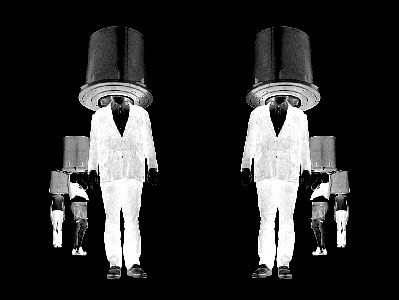
within a public (exhibition) space. The Intermedia Installation consits of five modified plastic barrels hung from
the ceiling of the exhibition space. The hollow objects separate
the interior and exterior space acoustically, as well as visually isolating the listener (i.e. audionaut) from the surrounding environment.
Each object has a circular hole on the bottom side; when sticking one's
head inside the object, a light sensor activates the sound (two speakers hidden
within the barrel). A light source illuminates the barrel
from within. The remaining exhibition space is dark, thus for 'external
observers' the 'listener' seems to fuse with the object. The
light situation and the his motionless listening position transforms the 'audionauts' into visual
components of the installation. Compositions presented in conjunction with Dissociated
Voices originate from the
work
series
bestimmung new york, a series of 15 voice sculptures based
on sound recordings in 15 languages. |
|
|
... |
|
|
Dissociated
Voices (1999) Intermedia Listening Stations for Five Audionauts (adapted plastic barrels, audio system, loudspeakers, photo sensors, light sources) Technical realization: Martin Murauer Many thanks to Joachim Baur, Josef Klammer, and Werner Dafeldecker. Photo credits: Source photography by J. Klammer/Werkstadt Graz. |
|
|
... |
|
|
Gromoga Art Space; December 1999 Sound
installation / CD-Presentation of bestimmung
new york |
Werkstadt Graz; May - June 2000 Solo
exhibition at Werkstadt
Graz, Graz; May 31 till June 25, 2000 |
|
... |
|
A Catalogue & CDR of Dissociated Voices has been published by Werkstadt Graz in May 2000.
Dissociated Voices has also been documented as part of Gal's Catalogue Book & audio CD 'Installations' (Kehrer, Germany 2005).
In 2001, bestimmung new york was awarded the interdisciplinary art award 'Karl-Hofer-Prize' of the University of Arts, Berlin.
        |
|
Gal
Dissociated
Voices As a sound engineer and someone who has done a lot of sound design, especially for theatre, and who has got a feeling for being able to do all sorts of three-dimensional things with music, Bernhard Gal set off to New York in 1997 - not just like that, like young people travel to other cities and countries, but rather in his capacity as an Austrian assigned to do community service as an alternative to military service at the Leo Baeck Institute in New York. Bernhard Gal had brought along his DAT-Man and his task at the Leo Baeck Institute was to conduct interviews with former Austrians who had been able to flee from the National Socialists directly or indirectly to New York. During the course of this work, the young composer also developed a keen ear for the sound and melody of spoken language and for the many languages he heard wherever he went in New York. To him, many of these languages were just one thing: sound and melody. Others also conveyed something meta-musical, while others again - above all those spoken by his interviewees for the Leo Baeck Institute - had a profound, meta-musical significance. It became increasingly clear to him that he himself, the receiver, determined what way the sequence of spoken words reached him, depending on his attention and his knowledge of the particular language. This ambivalent situation experienced in everyday life was the starting point for a concept that, once on CD as "bestimmung new york", ultimately ensured that Bernhard Gal became Gal, a young composer whose appearance in various contexts is meanwhile carefully observed. In New York it was first ten, then fifteen compositions which, with the aid of a sampler brought along later from Austria, were completed and soon after presented as an installation at a gallery. Back in Austria, Gal refined his ten New York compositions, adding five new ones to them to create "15 voices, 15 languages, 15 sound compositions",as gal himself writes, a "subjective excerpt of the multifarious cultural landscape of New York". It was New Yorker friends and colleagues who had spoken on tape the same sequences of words translated into their respective mother tongue. People listening to the fifteen voice pieces are transported to the situation that Gal felt to be ambivalent in New York in which they receive the compositions in different ways depending on their own language proficiencies - from language as sound and melody to friction with the (all too often) close familiarity with hollow phrases hackneyed by the popular media (albeit at least in different languages) like "I love you" or the numbers from one to ten that every long-distance tourist knows even in exotic languages. (...) During
his studies of music science, Bernhard Gal first devoted himself to questions of perception of music and psychoacoustics.
And he is so intensively occupied with questions concerning the reception
of his compositions that these have become the driving force for "installations"
on "bestimmung new york" featuring hollow bodies (barrels) suspended from
the ceiling: wherever the composer has the opportunity to define the parameters
for reception of his music, he does just that. He is not willing to let
go of control of the reception of his works, on the contrary, he tries
to fight against the fact that people eat and drink at many concerts,
or that the way CDs, radio or Internet broadcasts are received is completely
beyond the control of the composer. What he attempts to do, then, is to
predefine a situation of reception in gallery situations in such a way
that - in analogy to visiting an exhibition of pictures - a few moments
of ideal listening (could) occur. "These are stations of listening. It
is not music made for the room or that plays with the room and its acoustics
or size. I was interested in looking into the question as to how I can
present these voice pieces and make people listen to the pieces with maximum
care and attention. And that only works if you isolate people from each
other. If you put your head into the barrels hanging from the ceiling,
you can above all hear this piece one time, even if it's only for 30 seconds.
To me it was important to create an atmosphere in which you are somehow
on your own and somehow private. When you put your head inside, you are
really screened off and you can't see what's going on around you. You
are in a gallery or wherever among other people and, at the same time,
you are listening to the music with great privacy". (...) ( English translation: Richard Watts) |
|
|